

Two active wars.
Millions of drones.
All running on a two-dollar chip made by companies you’ve probably never thought about as defense stocks.
Last week, the U.S. fired its first-ever one-way attack drone during strikes on Iran. The Pentagon just launched a billion-dollar program to build attack drones at five thousand dollars each. Ukraine is producing over a million drones a year. Iran is launching waves of them as we speak.
When researchers tore apart an Iranian-made Shahed drone, they found about fifty-two electronic components inside. Roughly eighty percent of them were American-made. Not by defense contractors. By analog chipmakers.
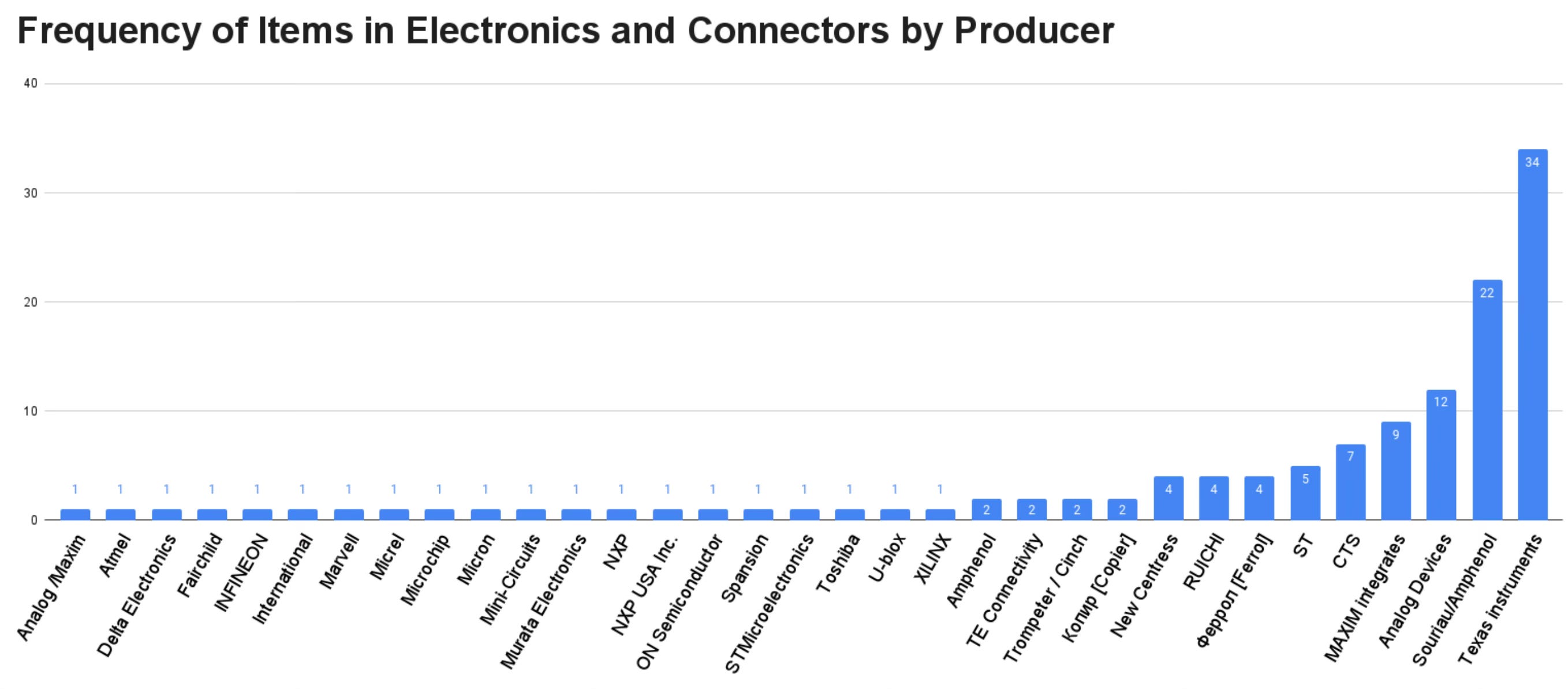
Premium Equity Empire subscribers already know about Texas Instruments TXN 0.00%↑ — the company whose parts showed up nearly two dozen times in those teardowns. I recommended the stock back in December. But TXN is just one of five semiconductor companies whose chips appear in virtually every military drone on the planet.
Here are the other four. Plus three pure-play drone makers worth having on your radar.
Analog Devices (ADI) — The Precision Play
Where Texas Instruments dominates on volume and breadth, Analog Devices ADI 0.00%↑ makes the higher-performance chips. Guidance systems. Radar. Electronic warfare. Signal processing. If a drone needs to do something precise - lock onto a target, process radar returns, jam an enemy signal - there’s a good chance ADI silicon is involved.
Of the five companies in these teardowns, ADI has the most direct and acknowledged defense exposure. Their aerospace and defense segment just hit a record quarter. Revenue surged thirty percent in Q1 2026.
The drone angle: ADI’s chips handle the sophisticated stuff - the sensing, targeting, and electronic warfare capabilities that separate a smart drone from a flying pipe bomb. As drones get more autonomous and more contested by electronic warfare, demand for this kind of precision silicon only grows.
NXP Semiconductors (NXPI) — The Secure Microcontroller
NXP NXPI 0.00%↑ microprocessors were found inside Shahed drone teardowns. They’re Dutch-headquartered but U.S.-listed, and about sixty percent of their revenue comes from automotive. But here’s where it crosses over - their secure microcontrollers and radar processing chips have direct military applications.
Think drone navigation systems. Identification-friend-or-foe modules. Encrypted communication links. NXP builds the kind of secure, hardened processors that military systems require when they need to verify what’s friendly and what isn’t - which matters a lot when you’ve got swarms of autonomous drones in contested airspace.
The drone angle: NXP’s automotive radar expertise translates directly to drone sensing and navigation. Their secure element chips are designed to prevent tampering and spoofing - critical when adversaries are actively trying to jam or hijack your drones.
ON Semiconductor (ON) — The Eyes and the Power
ON Semi ON 0.00%↑ plays a completely different role than the other four. They don’t make the brain of the drone. They make the eyes and the power system.
Their silicon carbide and gallium nitride chips handle power conversion in harsh environments. That’s critical for drone motor controllers and battery management - extracting maximum flight time and range from a small lithium-polymer battery. Their CMOS image sensors are literally the cameras on these drones. When an FPV pilot is flying a four-hundred-dollar drone into a Russian tank, the video feed coming back is running through ON Semi silicon.
ON Semi is less about showing up in Shahed teardowns and more about being essential to the next generation of autonomous systems that need better power efficiency and better vision.
The drone angle: Two critical functions — power management and imaging. As drones push toward longer range, longer endurance, and autonomous target recognition, both of these capabilities become more important, not less.
Microchip Technology (MCHP) — The Flight Controller Brain
Microchip Technology MCHP 0.00%↑ makes the microcontrollers and FPGAs that serve as flight controllers and mission computers in smaller drones. Their PIC and AVR microcontroller families are ubiquitous in embedded systems — the kind of cheap, reliable, low-power processors that run the basic functions keeping a drone in the air.
They explicitly serve aerospace and defense as a named end market. And Citi actually has MCHP as their top semiconductor pick for 2026, partly on the cyclical recovery thesis.
The drone angle: When the Pentagon says it wants drones at five thousand dollars or less, the flight controller needs to be dirt cheap and rock solid. That’s Microchip’s sweet spot. Their embedded processors are battle-tested across millions of industrial applications — and now they’re going into millions of drones.
The Pure-Play Drone Makers
The semiconductor companies are the picks-and-shovels layer. But there are also companies building the drones themselves. These are higher risk, higher reward - and more directly tied to defense procurement cycles/contracts.
AeroVironment (AVAV) — The Switchblade
AeroVironment AVAV 0.00%↑ is probably the most prominent pure-play drone investment right now. They make the Switchblade family of loitering munitions — essentially kamikaze drones that a soldier launches from a tube, flies to a target via live video feed, and detonates on impact.
The U.S. Army just awarded them a hundred and eighty-six million dollar order for next-gen Switchblade 600 and 300 variants, under a broader contract ceiling near a billion dollars. The Switchblade has been battle-tested in Ukraine and proven effective against armored vehicles and personnel.
Stock: ~$260, up 71% over the past year The catch: Trades at roughly 150x trailing earnings. That’s a steep premium even for a high-growth defense name. You’re paying for the future here.
Kratos Defense & Security Solutions (KTOS) — The Drone Dominance Contender
Kratos KTOS 0.00%↑ is in the Pentagon’s new Drone Dominance program - the billion-dollar initiative to mass-produce cheap attack drones. They build target drones, tactical unmanned systems, and have a long history with the military’s drone programs.
What makes Kratos interesting is they already know how to build drones at scale for the military. Their Valkyrie autonomous combat drone has been in development with the Air Force. The Drone Dominance program could be a significant revenue catalyst if they’re one of the final twelve vendors selected.
The angle: Less pure-play “drone stock” and more diversified defense technology company with meaningful drone exposure. Lower valuation risk than AVAV.
Red Cat Holdings (RCAT) — The Small Drone Winner
Red Cat RCAT 0.00%↑ won a major Army contract in late 2024, replacing Skydio as the military’s small reconnaissance drone supplier. These are the handheld drones that soldiers carry in their packs and launch for immediate situational awareness.
This is the smallest and most speculative name on this list. But they’re positioned in the fastest-growing segment - small tactical drones that every infantry unit will eventually carry as standard equipment.
The angle: High-risk, early-stage company that just landed a meaningful contract. The small drone category is where volume will be highest - but execution risk is real.
The Supply Chain Angle
One thing that ties all of these companies together - semiconductor and drone maker alike - is the supply chain.
China controls ninety percent of the global commercial drone supply chain. Carbon fiber frames, rare-earth magnets, lithium-ion cells, gallium-nitride chips, flight controllers, sensors. In September 2024, China imposed export restrictions on drone components to both Ukraine and Russia. Then in April 2025, they suspended exports of critical minerals and magnets entirely.
The Pentagon now requires “Blue UAS” compliance - or no Chinese components in anything sensitive. That’s a reshoring tailwind for every American semiconductor and particularly Texas Instruments which manufactures the chips domestically.
Same playbook as the CHIPS Act for advanced semiconductors. But this time it’s for the low-end analog and embedded chips that go into every drone flying today.
The Bottom Line
The companies behind the drone boom aren’t Lockheed and Raytheon. They’re analog chipmakers and small defense firms whose products show up in every drone on earth.
This is an idea generation piece - and other than Texas Instruments (and possibly NXPI) none are on my buy list. Each of these companies has a different risk profile, a different exposure level, and a different reason to be watching them. But the thesis is simple: drones are the defining weapon of modern warfare, their production is scaling to levels nobody anticipated even two years ago, and the companies supplying the guts deserve to be on your watchlist.
Seven names. One tailwind. Do your own research from here.
For more on Texas Instruments specifically — including why I recommended it to premium subscribers back in December — watch the full video breakdown